
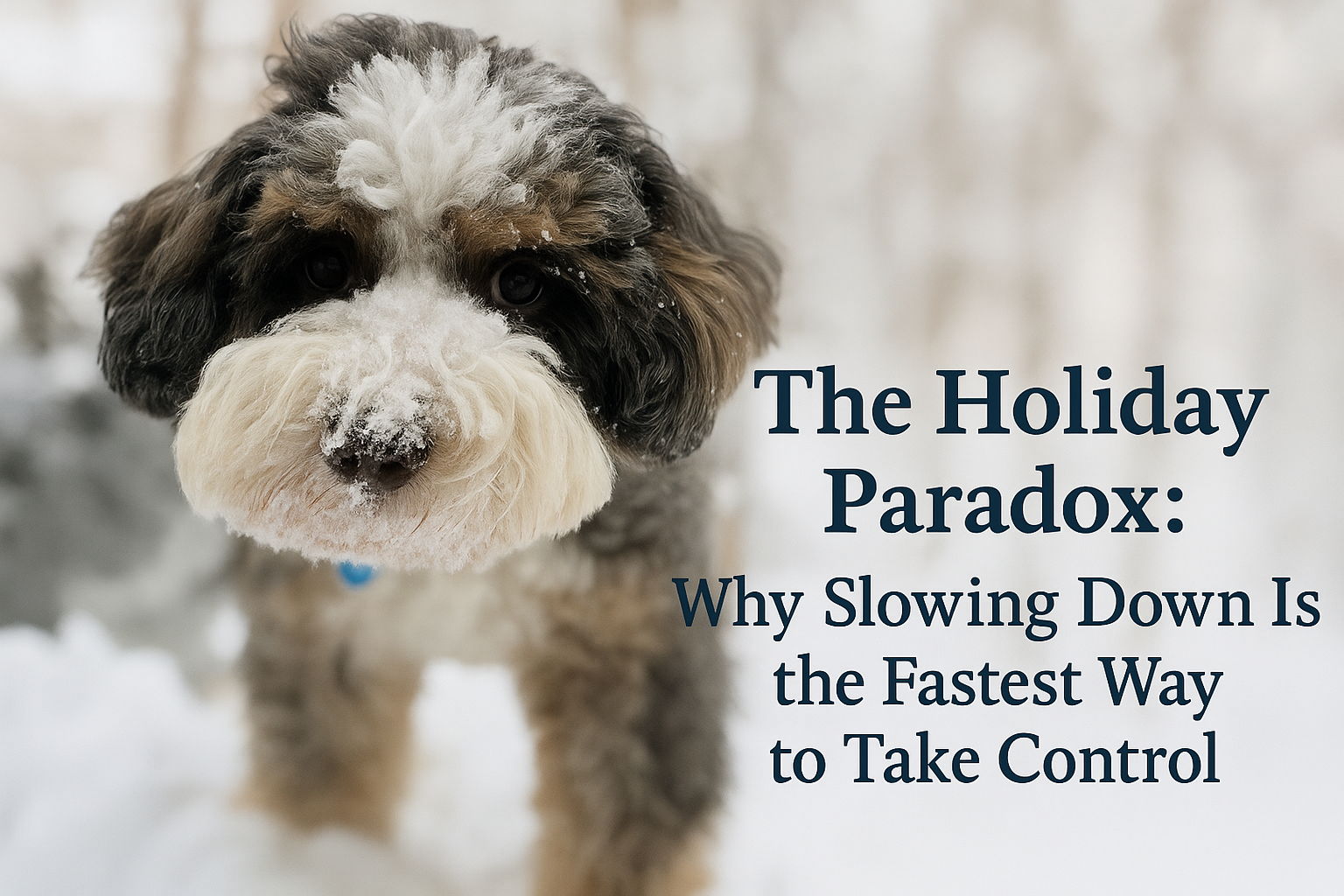
It has been a long holiday weekend. We were buried under ten inches of snow, I’m 20 hours away from finishing a seven-day stretch of call that included the holiday, and somehow I still managed to get Thanksgiving dinner on the table. The kind of stretch where your brain feels like it has too many tabs open and your body is running on fumes.
When I finally stepped outside to let the dogs out, I was grumpy. But the moment the pups hit the snow they cracked my crusty exterior. They bounded through the drifts like it was the greatest discovery of their lives. And before I could stop myself, I felt my shoulders drop. My breath deepened. Something in me softened.
It wasn’t that the stress disappeared. It’s that their simple delight reminded me of something I teach all the time but often forget in the thick of life: Sometimes the fastest way to regain control isn’t by doing more, it’s by interrupting the cycle long enough to remember what matters.
That’s the exact tension I explore in this week’s blog post on taking control of stress. The science is clear: When stress ramps up, our instinct is to double down. But your nervous system doesn’t need intensity; it needs clarity. It needs space. It needs permission.
And the holidays bring this conflict into painfully sharp focus. You’re expected to be joyful, grateful, and present while your clinical workload stays the same, the inbox grows, and the gap between “what I want to feel” and “what I can realistically manage” feels impossibly wide.
No wonder so many physicians tell me December is when their stress peaks.
But what if control isn’t about adding more tools or squeezing more discipline out of yourself? What if control actually lives in intetionally choosing what stays and what goes?
You don’t have to control your thoughts. You just have to stop letting them control you.
— Dan Millman
Coach's Corner
The “Keep / Release” Reset (5–7 minutes)
- Find five minutes in the next day and ask yourself:
What is one thing I’m doing (or committing to) this holiday season that drains me more than it supports me?
This might be:
– A task
– A tradition
– A responsibility
– A belief (“I have to be everything for everyone,” “I should be able to handle this,” “I shouldn’t be this tired”)
Write it down. - Then ask:
What would it cost me to release this?
(Not the surface cost—the emotional one: guilt, judgment, disappointment.) - Finally ask:
Is that cost worth the freedom I’d gain?
– Sometimes the answer is yes — you keep the commitment.
– Sometimes the answer is no — and you choose release.
Either way, you move from reactivity (feeling trapped) to intentionality (feeling empowered).
That shift is what real control feels like.
If you’re reading this and thinking, “I know I need better boundaries, but I don’t know where to start,” or “I can handle the stress, but I’m losing touch with why I went into medicine,” you’re in good company. So many physicians I work start out feeling exactly this way.
The holidays are an invitation to pause and ask yourself what you want life and medicine to feel like in the year ahead.
If you’re ready to explore that with guidance, whether through coaching, a course, or simply by stepping into a community where these conversations are normal, here's how I can help.
You deserve a life in medicine that nourishes you.
With warmth and belief in what’s possible,
Ben



Responses