
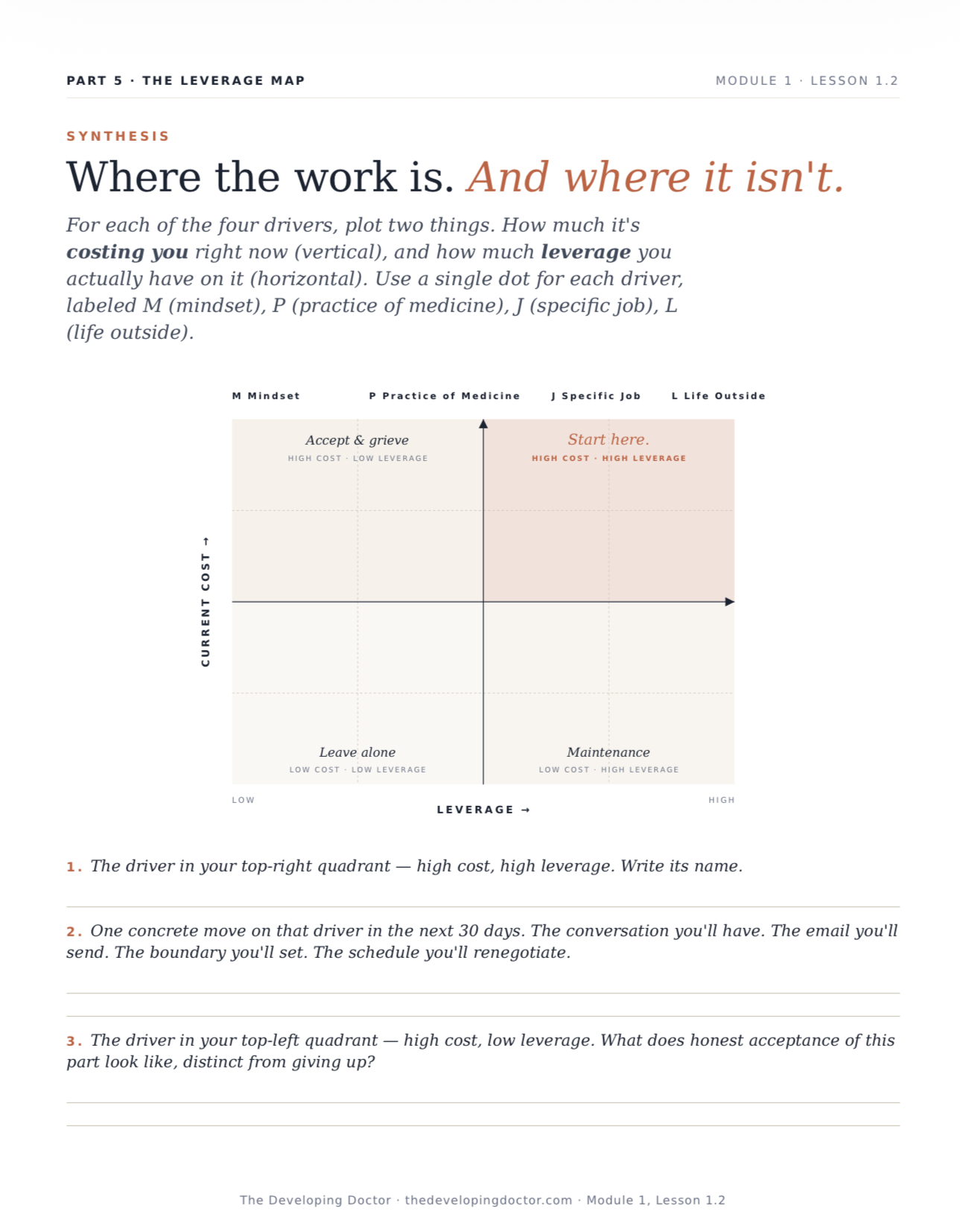
Module 1 · Worksheet 1.2
Plot the four drivers of your current depletion against cost and personal leverage. The top-right quadrant is where the work starts.
For physicians who want to rebuild a career they can sustain — whether you stay, step back, or step out. Short coached lessons, three professional assessments, and a written plan you keep using.
14-day full refund · Lifetime access · Often reimbursable from CME funds
Coaching modules: Identify, Align, Develop, Sustain
Short video lessons, most under ten minutes
Professional assessments included: VIA, DISC, EIQ
Lifetime access & return visits
A moment from the emotional intelligence module, on why difficult conversations so often go wrong before anyone says a word.
You stayed late on a Tuesday and missed dinner again. You answered an inbox message during your kid's recital. You sat through a meeting where someone called you a high performer and cut your pay in the same sentence — and walked out unsure which part was the lie.
The story has different shapes. You were just promoted, and the promotion looks a lot like a third job. Or you asked to move two patients so you could pick up your kids one night a month, and people who have never met you said no. Or you got paged about a scheduling question during a real emergency, snapped, and sent the message you swore you'd never send.
None of it is a personal failure. You keep saying yes because you mean it — and that is not the part that needs fixing. You are still the doctor people are lucky to get. What is missing is the structure that lets you stay that way for the next twenty years, without shrinking the rest of your life to do it.
You don't have a productivity problem. You have a life that has been measured by RVUs and gotten smaller.
Medicine is still worth doing. The trick is doing it without disappearing.
By the end of the course, you'll have a blueprint for the next chapter of your career. You'll write it section by section as you move through the modules. You'll come back to it quarterly. You'll keep it for the rest of your career.

Inside the workbook
The work isn't a list of journaling prompts. It's a sequence of structured instruments — one per lesson — each designed to be printed, completed in pen, and carried into the next one. A few pages, from across the modules.
Module 1 · Worksheet 1.2
Plot the four drivers of your current depletion against cost and personal leverage. The top-right quadrant is where the work starts.
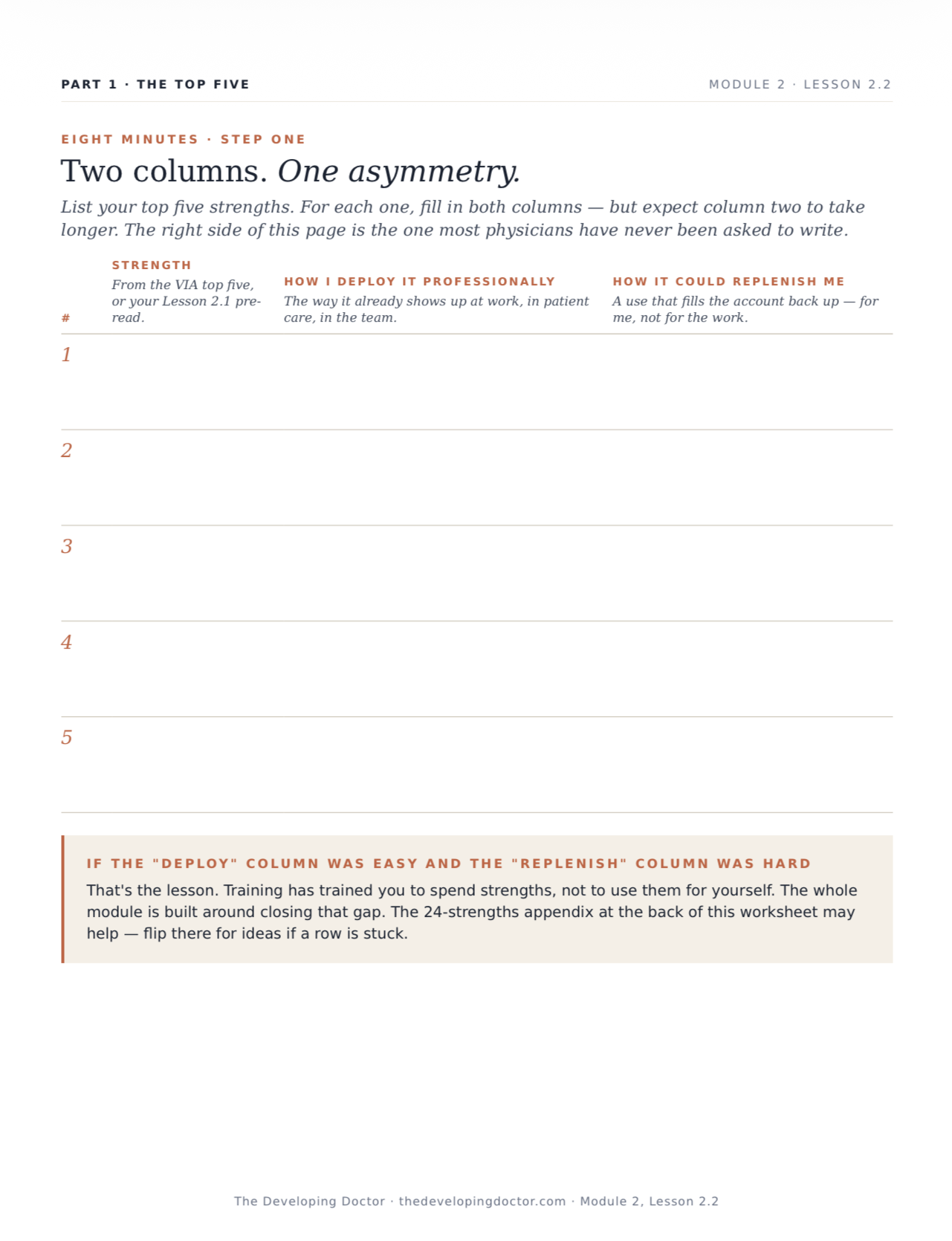
Module 2 · Worksheet 2.2
Your VIA strengths in two columns. The first you can fill in your sleep. The second is the column most physicians have never been asked to write.
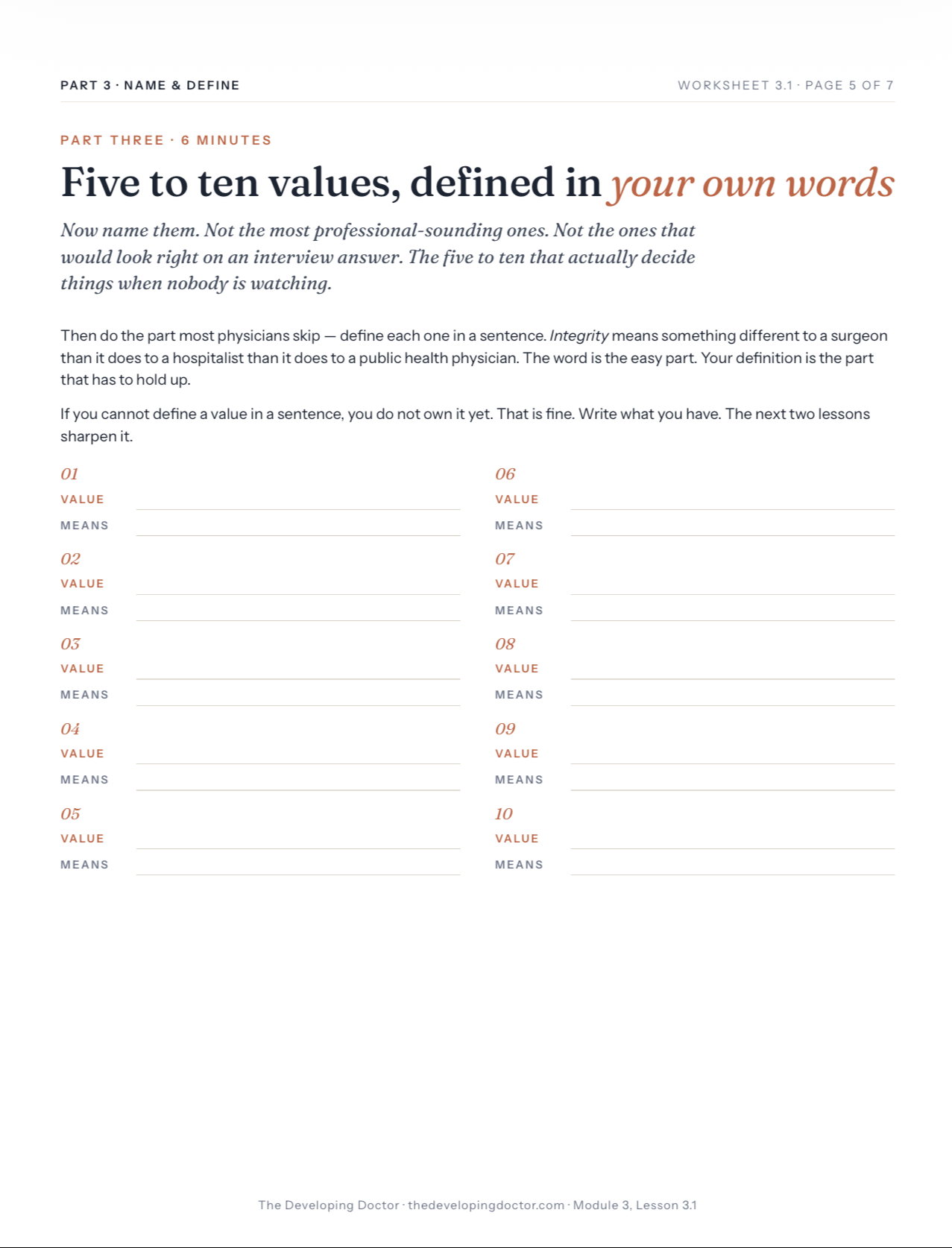
Module 3 · Worksheet 3.1
Five to ten values, defined in your own words. The word is the easy part. Your definition is the part that has to hold up.
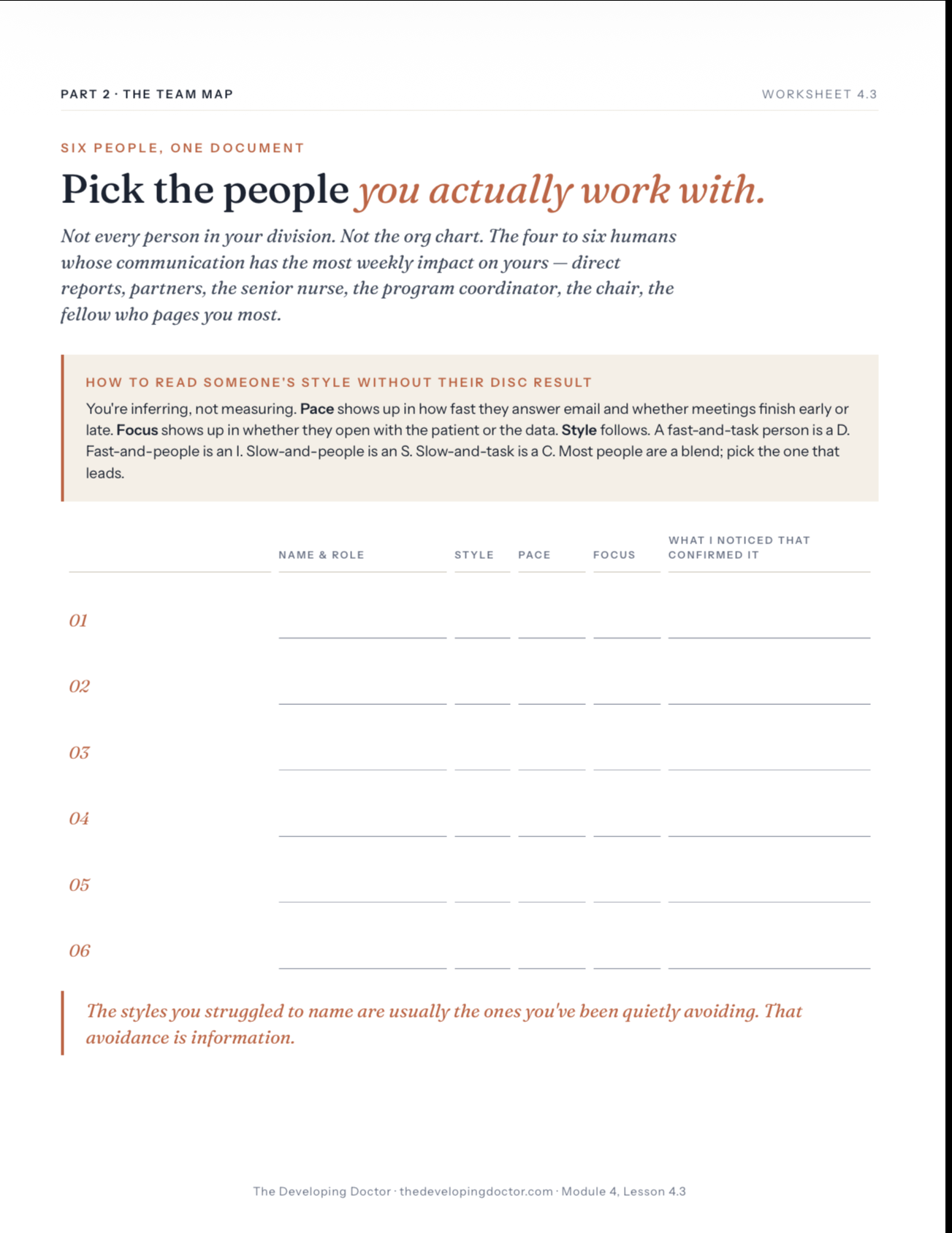
Module 4 · Worksheet 4.3
Four to six colleagues, mapped on the same axes as you. The asymmetry is where most of your communication friction comes from.
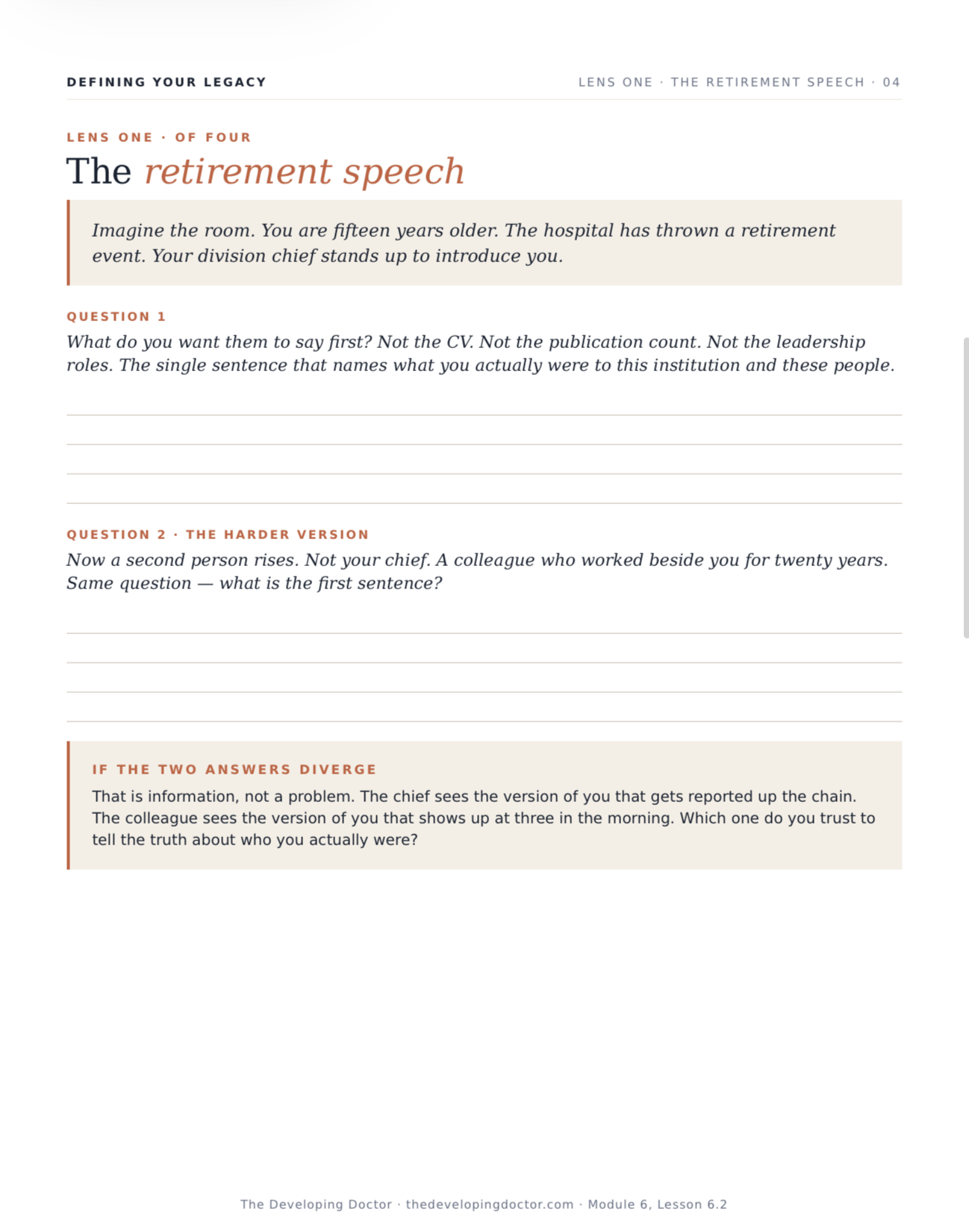
Module 6 · Worksheet 6.2
One question, asked four times through four different lenses. The retirement speech is the first.
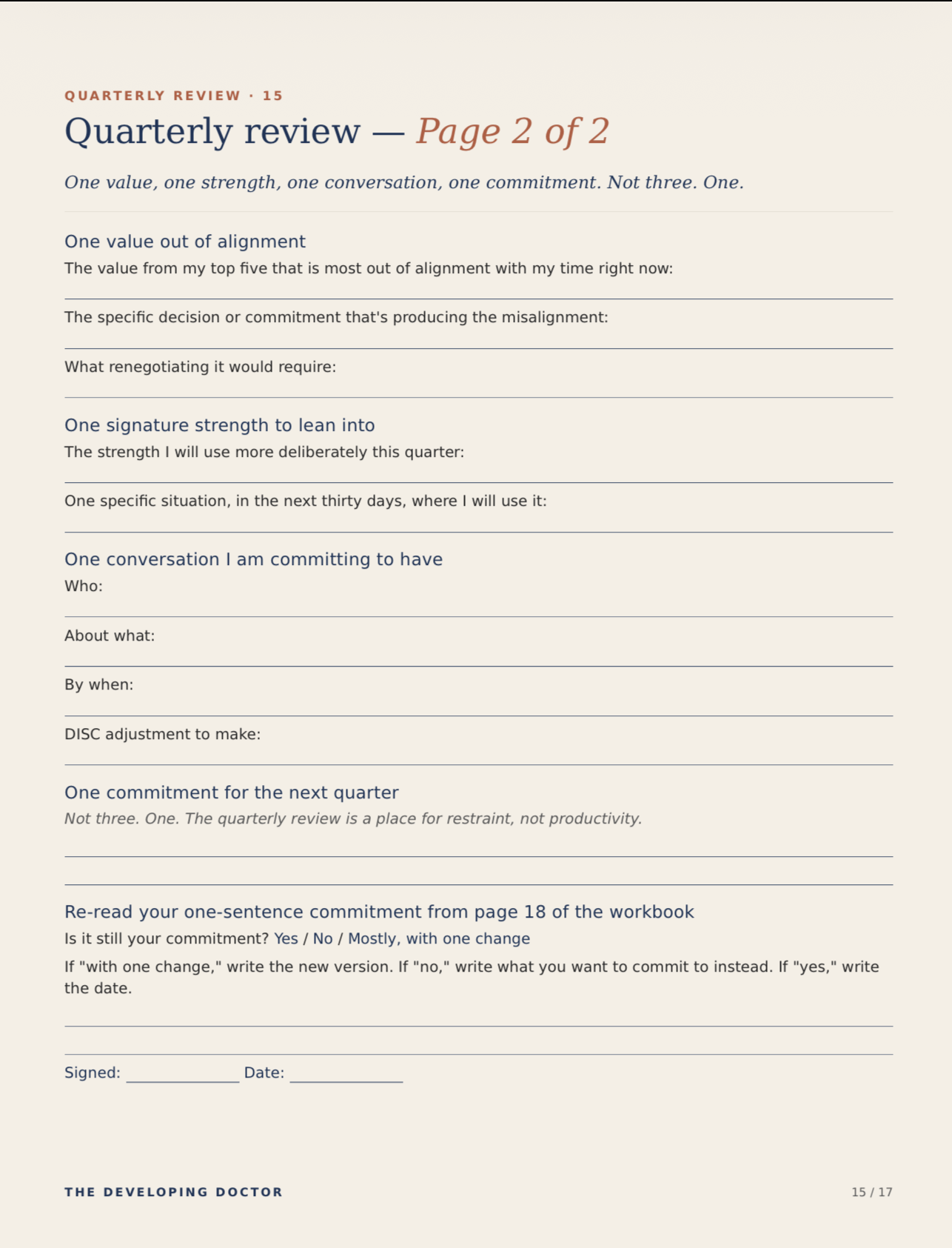
After the course · The Sustainable Practice
One value out of alignment. One strength to lean into. One conversation to have. Forty-five minutes every three months for the rest of your career.
The eight modules are grouped into the four phases of the career architecture method. You move through them in order. Each lesson is under ten minutes. Each module ends with a section of the workbook you'll have written by the time you're done.
Name the four specific reflexes your training built into you on purpose — perfectionism, working through anything, hiding flaws, suppressing emotion — and learn three concrete techniques for interrupting the inner voice that's been running you since med school. By the end you'll have stopped reading your own exhaustion as a personal failure.
Pinpoint which specific drivers of physician burnout are operating in your life right now — not generally, specifically. Walk away with concrete practices for refilling the physical, emotional, and spiritual reserves the work has been quietly draining, plus a thirty-second between-patient reset you can start using tomorrow.
Identify your top five character strengths and see exactly how they show up in your practice today. Figure out which signature strength you've been underusing — the one that goes flat under stress — and walk away with one specific way to use it differently this month.
Name the five values that guide your best decisions — including the ones nobody told you to value. Identify the one decision you're making right now that conflicts with them. Write a mission statement you'll come back to the next time something hard needs deciding.
Understand why certain colleagues feel impossible to talk to — not because they're difficult, but because they're wired differently — and learn how to flex without giving up your spine. Pick two specific relationships in your life that need handling differently. Leave with a concrete plan for both.
Build the four capacities that separate physicians people follow in a code from physicians people work around: self-awareness, self-regulation, social awareness, relationship management. Includes a self-debrief framework you'll use after the next high-pressure case to learn from it instead of replaying it at 2am.
Define the one word you want people to remember you for. Turn it into a five-year intention statement — short enough to say out loud when someone asks what you're working toward. Translate it into three goals you'll keep — specific enough to measure, small enough to start tomorrow. End with the practice that lets you stay on the path when a hard week tries to pull you off it.
Walk through every direction a physician career can move — clinical on your terms, hybrid, non-clinical, or fully outside medicine — without anyone telling you which one to pick. Leave with a clear sense of which direction is calling, and what the real trade-offs of that choice would look like in practice.
The course leaves you with thirty-six completed worksheets. The Sustainable Practice is what keeps you returning to them. Three quick-reference cards for the clinic drawer — DISC at a glance, the four EIQ pillars and their repair moves, your top five strengths. Five "When X Happens" situation sheets for the conversations medicine produces on schedule: the difficult one, the team meeting gone sideways, the case you can't stop replaying, work coming home, the snap moment. A two-page quarterly review you'll actually finish. And a twenty-four-prompt self-coaching deck, organized around the same four phases as the course, for the quarter when you're stuck.
Thirty-six recorded lessons, deliberately short. Watch one between patients, on a commute, or in the half-hour after the kids go to bed. Every lesson finishes a thought.
Every lesson ends with a worksheet or a piece of self-work that continues after the video. All printable, fillable PDFs. Together they build into your career blueprint.
No cohort dates, no group threads, no shared screens. Start the day you enroll. Finish in a weekend or stretch it across six months. Lifetime access means you come back when something changes.
Approved for 12 AMA PRA Category 1 Credits™, jointly provided with the Postgraduate Institute for Medicine. Reimbursable through most institutional CME budgets.
I'm a board-certified pediatrician and pediatric cardiologist. I run a clinical division inside an academic medical center. I sit on faculty at the University of Iowa. I trained the way you trained.
And the message I got from day one of medical school was the one you got too — that being a good doctor and being a whole person were two things you had to choose between. The first time I called in sick during residency, covered in hives, the chief resident asked if I knew how busy clinic was. That sentence shaped me. I suspect a version of it shaped you.
I tried meditation, medication, therapy, time blocking, taking weekends off. None of it touched the underlying problem. What finally did was coaching — a method, a framework, and the written work of putting my own values, strengths, and next moves on paper, with someone else's help. That's the same work you'll do here, one lesson at a time. I rebuilt the method into a course for physicians who want to do this work quietly, in the hours they can find, before deciding whether to do anything else with it.
I'm still in clinic. I still lead a division. I do this work because it's the work I needed and couldn't find.

No subscriptions. No upsells inside the course. You buy it once, you have it for as long as the platform exists, and you come back to it whenever the document needs revising.
The cost of getting your life back. Once.
Some physicians do the course and want to take what they found further — with the work tailored to what they're navigating right now rather than a curriculum. Coaching with Ben is built for exactly that. Two packages, both virtual, both anchored in the same assessments and the same Identify, Align, Develop, Sustain framework as the course.
Plan on about twelve hours of work, total — combining the video lessons and the workbook reflection. Lessons are deliberately short, most under ten minutes, so you can finish one between patients or after the kids are down. The workbook is where the real work happens — written reflection, the assessments, the document you'll keep. Most physicians spread the twelve hours across four to eight weeks. Some compress it into a long weekend. The work doesn't expire, so the speed is yours to set.
Thirty-six short video lessons across eight coaching modules. Three professional assessments — the VIA Inventory of Strengths, DISC, and EIQ — included in your enrollment with no separate purchase. A worksheet with every lesson, which together form the career plan you'll write as you move through the course. 12 AMA PRA Category 1 Credits™. And The Sustainable Practice — Field Tools, the durable companion you keep using long after the last lesson. Lifetime access to all of it.
Fourteen days. If you've started the course and decided it isn't the right fit for you, write to us within fourteen days of enrollment for a full refund. No questions, no friction. We'd rather you do work that helps you than feel stuck in something that doesn't.
The course is approved for 12 AMA PRA Category 1 Credits™, jointly provided by the Postgraduate Institute for Medicine (PIM) and The Developing Doctor. The credit is included with enrollment — no separate fee — and most institutional CME budgets reimburse it. When you finish the lessons and the activity evaluation, you claim your credit and download your certificate through PIM's portal.
You're handed The Sustainable Practice — Field Tools, a separate companion designed to be used for years, not weeks. Three quick-reference cards for the clinic drawer. Five "When X Happens" situation sheets for the conversations medicine produces on schedule — the difficult one, the team meeting gone sideways, the case you can't stop replaying, work coming home, the snap moment. A two-page quarterly review you'll actually finish. And a twenty-four-prompt self-coaching deck for the quarter when you're stuck. Most physicians who complete the course return to their worksheets every three months. The Sustainable Practice is what makes that return easy.
The course is self-paced, structured around a set curriculum, and $475. One-on-one coaching is built around whatever you're navigating right now, with live sessions and personal feedback from Dr. Reinking, and starts at $2,100 for six sessions. Both use the same framework and the same assessments. Many physicians do the course first and bring their completed plan into coaching later.
Yes — most of it. The reflective work, the assessments, the workbook, the goal-setting, the framework: all of it is designed to be done alone. What a coach adds is real-time pushback, the experience of saying things out loud to someone who understands the practice, and the accountability of a calendar. If those are essential for you, choose one-on-one coaching. If you want to do the work first and decide later, this is the right starting point.
Good. The course is most useful done preventively — before the accumulation gets to a point where leaving feels like the only option. Physicians who do this work early treat it as career maintenance: a quarterly return to the document, the way you'd return to your retirement plan or your physical exam. The earlier you start, the more useful it is.
The course doesn't tell you whether to leave. It helps you see clearly enough that whatever you decide is a decision you made on purpose, not a decision that medicine made for you. The bonus module covers the four directions a physician career can move — including outside — without prescribing any one of them.
Not directly within the self-paced course. Personal feedback and live access to Ben are part of what one-on-one coaching provides. If you want that access, coaching is the right place. The course provides Ben's voice through the lessons and the workbook design, but not real-time interaction.
Dr. Ben Reinking — a practicing pediatric cardiologist, division director, and Master Certified Physician Development Coach. The course is built from the same coaching method Ben uses with private coaching clients. His story and credentials are in the founder section above.
But you do have to make the choice. This course is what you do before the next big decision — the job, the leadership role, the step back, the step out, the conversation you've been rehearsing for a month.
Enroll now — $475