
The Premed Second Opinion
Should you apply this year?
A close review of everything you send me, an hour of real conversation, and a written opinion and action plan you keep — from a physician who has read medical school applications from the inside, and who has no acceptance rate to protect.
$500, or two payments of $250 · A full review, a coaching session, and an action plan
The problem
You have plenty of places to turn. None of them are neutral.
Your advisor
They know the system and they know the deadlines. But how well do they know you? Most have never sat on an admissions committee, and most have never practiced medicine.
A consultant
Me included. Anyone selling you help has a reason to tell you that you need it. The honest question isn't whether we're neutral — it's what we're willing to say when the answer costs us the sale.
The internet
Free, frequently right, occasionally cruel. It will answer your question honestly and then tell you that if you had to ask, you don't want it badly enough.
Friends and family
They want the best for you. That doesn't mean they can be unbiased about it, and it doesn't mean they know what you actually need to know.
What you get
One of four answers.
Every Second Opinion ends with a simple assessment, the reasoning behind it, and a plan underneath it. That assessment is based on what you submit, recent national admissions data, and my experience. In the end, it is my best attempt at an objective and honest read.
01
Apply this cycle
You're ready and the application is solid. Here's what to protect and what not to touch.
02
Apply next cycle
Not ready now, and clearly fixable in twelve months. Here's what the year is for.
03
Build the foundation first
This is a two-to-three year plan, not an application problem.
04
Reconsider the path
Becoming a physician may not be the right fit — but medicine is bigger than MD and DO. Nursing, PA, therapy: real paths, not fallbacks.
One of these is hard to share and hard to hear. I'll still say it. Sometimes support means saying hard things.
Meet Dr. Ben
I've walked the path, worked in admissions, and been the cheerleader, the support, and the listening ear as my own kids became doctors.
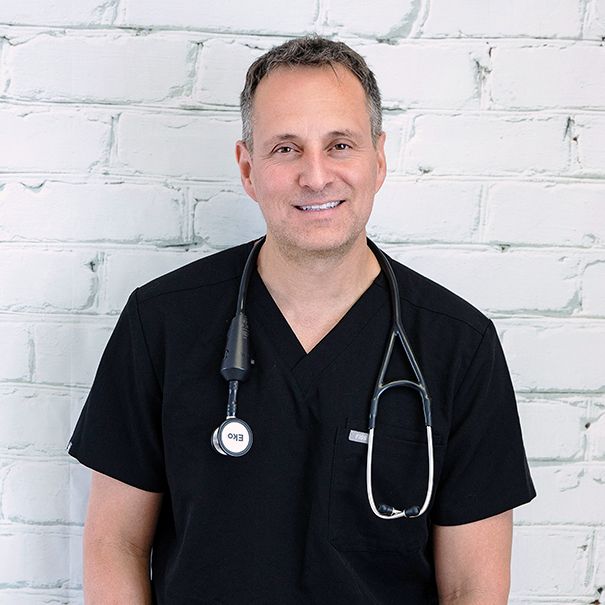
I'm a pediatric cardiologist and the division director of pediatric cardiology at an academic children's hospital. I served on our medical school's admissions committee for eight years, and I interview candidates now.
I'm also a learning community director at our college of medicine. That means I meet M1s on their first day of orientation, coach and support them through medical school, help them find the specialty that fits, and write the final paragraph of their MSPE — the letter their school sends describing who they turned out to be. I'm there at the white coat ceremony, and I'm there on Match Day.
I'm a trained coach, and that matters more here than it sounds like it should. Most qualified applicants are not rejected because their personal statement was poorly written. They're rejected because their application never told a story about who they are, why they want to be a physician, and what they bring to the field. You can't edit your way to that.
And I've watched two of my own kids go through it. One is a budding neonatologist. The other is an ER doc. I watched them apply, and I watched them grow up and start their own families in the middle of training.
How it works
Three parts. One honest answer.
1
The review
You send everything you have — transcript, MCAT score or target, activities, your letter plan, a draft personal statement if one exists — plus a written intake designed to give me the full picture. Some of those questions are hard to answer, and some will be things you haven't considered. That's the point. Then I read all of it, the same way I read applications when I served on the admissions committee. That work happens before we ever speak.
2
The conversation
An hour, live — a conversation and a coaching session. I'll give you my impression of everything you sent: how your application reads to someone on an admissions committee, what it says about you, and what it leaves out. Then we get into the questions underneath the one you came in with. Because the reading is already done, none of the hour goes to catching me up. It's recorded, and the recording is yours.
3
The plan
A written opinion and action plan, within five business days. My answer and the reasoning behind it, how your application reads from an admissions committee's perspective, where it holds together and where it doesn't, the three things that would move it most, and a timeline against the real application calendar. Yours to keep, re-read, and hand to whoever else is helping you.
What I won't do
I won't guarantee admission.
Every med school coach and consultant publishes a success rate. I think that number misses the point, and I think it misleads.
I can't control your GPA or your MCAT score. I can't control what your letter writers write, or how a committee reads your application on the day they read it. Nobody selling you help controls those things — which is why a success rate tells you more about who a company chose to work with than about what they did for them.
What I can give you is an honest, informed assessment of where you stand, what is likely to help, and what is likely to hurt. The rest is out of my control, and I'd rather say so plainly than imply otherwise.
This is for you if
- You're deciding whether to apply this cycle, and a little voice in your head is whispering doubts.
- You're a reapplicant and you're not sure what to work on.
- Someone told you this path isn't for you, and you want an honest second opinion — and options.
- You're three years in and quietly not sure this is what you want.
- You're a parent trying to help without making it worse.
This isn't for you if
- You want your personal statement edited. That's a different service and I'll point you to it.
- You want MCAT tutoring. I don't do that, and you shouldn't pay a physician to.
- You want a guarantee. See above.
$500
or two payments of $250
A full review of your application, an hour of real conversation, and a written action plan you keep.
I take a small number of these at a time. If the calendar is closed, the waitlist is honest about how long.
A note on conflicts. I take this work seriously, and part of that is being careful about who I should and shouldn't advise. I ask about conflicts of interest at checkout, before you pay.
Questions
Is an hour really enough?
The hour isn't what you're buying. Most of the work happens before it — reading your application properly takes longer than the call does — and the rest happens after, when I write the plan. The hour is conversation, coaching, and making sure I have the full picture of who you are. It isn't interview coaching, but it is good practice talking with a physician in an interview-like setting. Consider that a bonus.
What if the answer isn't what I want to hear?
I promised you an honest assessment. What you do with it is up to you — you can set it aside and apply anyway, make changes based on it, or choose a different path entirely. In my experience, most people who receive hard news already had some idea it was coming. What they want is validation and support with the next steps. That's what this is. And you'll have it in September, rather than finding out in March after you've spent three thousand dollars on applications.
How is this different from talking to my pre-health advisor?
A good advisor is genuinely useful. But they're managing a lot of students at once, and most have never practiced medicine or worked inside a college of medicine. I've spent twenty years inside one — eight of them on the admissions committee, and eight walking medical students from orientation to Match Day — and I'll have read everything you sent before we talk.
Can I bring a parent?
Yes. Say so on the intake form so I can plan the hour. I'd rather have the real conversation once than have it relayed badly twice.
Do you write essays?
No. I'll tell you what your essay is missing, and I'll tell you when the problem isn't the essay at all — which it usually isn't.
The Developing Doctor · Ben Reinking, MD